What I liked about this class was that we focus on one theme and not a number of them. I also like using the Internet to turn in work instead of handing in a hard copy paper. It just makes thing more simpler. I liked the theme itself, I like also everything about supernatural except for vampires, so I liked that we talked about about after supernatural creatures and things and not vampires. Why would I recommend student to this course? I would recommend to this course because this class is being us into the future of learning. This course mostly uses technology, because of that we're able to be free of handing in hard-copy papers and buying textbook. If you like or love supernatural, this course lets you learn everything you need to know to pass English 102 but using a theme that both the teacher and students will enjoy.
Monday, June 14, 2010
Monday, June 7, 2010
Blog 15 Final Draft
Fallen is about two teenagers, Lucinda Price and Daniel Grigori, who are doomed to fall in love with each other repeatedly. But there's something special about Daniel that, not only Luce, but almost the whole student body doesn't know that Daniel is a fallen angel. There's also a side story of how the fallen angels are apart of a long lasting war with each other, the Good angels versus the Bad angels.
The approach I plan on using is Archetypal Criticism. The main characters, Luce Price deals with shadows haunting her since she was 7 years old, while Daniel Grigori deals with falling for the same woman every 17 years. Both deal with Archetypal Criticism in there own way, but both deal with the same Archetypal, the death-rebirth myth. Daniel is doomed to fall in love with the same girl every 17 years and with a kiss she dies. Luce doesn't know about it yet but she's the woman that Daniel falls in love with every 17 years. With a kiss from him Luce dies, and is then reborn as a new person, and 17 years later she meets Daniel again. The reason why they're both doomed to this life is because one is a fallen angel while the other one is immortal. The death-rebirth myth was discovered by James G. Frazer, a Scottish anthropologist. Fallen follows Frazer's theory, death(Fall), rebirth(Spring). Lucinda's birthday between Spring and Summer, when she is reborn. After her 17Th birthday, she meets Daniel in the Fall which is close to her death. In the prologue, the Lucinda and Daniel at that time, it stated the year and the month which is September 1854, and September is when people start to harvest. So basically Frazer's theory goes along with the story: the death stage comes around the fall when the final crops are harvest while the rebirth stage comes around when you see the first sign of crops blooming.
In the novel Luce dealt with shadows all during her life. She started seeing them at the age of 7. Her parents thought that she was having eye problem so they sent her to the eye doctor, but she kept seeing these shadows. These shadows came so often that her parents took her to see a psychologist and they put her on medication to calm her down. But even the medication didn't stop these shadows from appearing. Jung states that people shadows appear to them in dreams or visions but in Fallen, Luce is never asleep when these shadows come about. Jung also states that the shadow has something to do with your unconscious mind but with Luce I believe that it has everything to do with the conscious mind. I agree with Jung about the shadow being darker than the person. in the novel Luce states that after her 17Th birthday she was these shadow creatures more. Even when she was around Daniel she saw the shadow creatures. So the shadow creatures could represent a warning about her becoming death and that is has something to so with Daniel. So we come to this conclusion, most of this novel follows Frazer theory more than Jung's theory.
Kate, Lauren Fallen. New York: Delacorte Press: Random House, 2009. Print.
"Archetypal literary criticism ." Wikepedia, 26 May 2010. Web. 13 June 2010
Posted by L. J. Lewis at 6/07/2010 10:14:00 AM 0 comments
Monday, May 24, 2010
Blog 13(half complete)
As I said in Blog 11 the book I have chosen was Fallen by Lauren Kate. The approach I plan on using is Archetypal Criticism. The main characters, Luce Price deals with shadows haunting her since she was 7 years old, while Daniel Grigori deals with falling for the same woman every 17 years. Both deal with Archetypal Criticism in there own way, but both deal with the same Archetypal, the death-rebirth myth. Daniel is doomed to fall in love with the same girl every 17 years and with a kiss she dies. Luce doesn't know about it yet but she's the woman that Daniel falls in love with every 17 years. With a kiss from him Luce dies, and is then reborn as a new person, and 17 years later she meets Daniel again. The reason why they're both doomed to this life is because one is a fallen angel while the other one is immortal. The death-rebirth myth was discovered by James G. Frazer, a Scottish anthropologist. Fallen follows Frazer's theory, death(Fall), rebirth(Srping). Basically Frazer theory is: the death stage comes around the fall when the final crops are havest while the rebirth stage comes around when you see the first sign of crops blooming. In the prologue, just by the way of the words, the author describes the setting of the place and weather.
Posted by L. J. Lewis at 5/24/2010 09:59:00 AM 1 comments
Monday, May 17, 2010
Blog 12 Pre-writing
Posted by L. J. Lewis at 5/17/2010 09:49:00 AM 0 comments
Monday, May 10, 2010
Blog 11
The plot for Fallen is: Seventeen-Year-Old Luce is a new student at Sword & Cross, an unwelcoming boarding/reform school in Savannah, Georgia. Luce’s boyfriend died under suspicious circumstances, and now she carries the guilt over his death with her as she navigates the unfriendly halls at Sword & Cross, WHERE every student seems to have an unpleasant—even evil—history.It’s only when she sees Daniel, a gorgeous fellow student, that Luce feels there’s a reason to be here—though she does not know what it is. And Daniel’s frosty cold demeanor toward her? It’s really a protective device that he’s used again . . . and again. For Daniel is a fallen angel, doomed to fall in love with the same girl every 17 years . . . and watch her die. And Luce is a fellow immortal, cursed to be reincarnated again and again as a mortal girl who has no idea of who she really is.
Fallen has a Wikipedia Fallen: http://en.wikipedia.org/wiki/Lauren_Kate#Fallen
The critical approach I plan on using is Jungian psychology, or shadow aspect. The reason why I'm choosing this approach is because all in the book it talks about Luce seeing shallows around her.
Posted by L. J. Lewis at 5/10/2010 10:47:00 AM 0 comments
Wednesday, April 28, 2010
Blog 7 Hero Quest
The film I have chosen was The Wiz: The Musical. It follows the Monomyth.
Dorothy is the heroine in the movie. The heroine in the movie following these steps of monomyth:
The Call to Adventure
Refusal of the Call
The Crossing of the First Threshold
Supernatural Aid
The Road of Trials
Woman as Temptress
Atonement with the Father
The Ultimate Boon
The Magic Flight
The Crossing of the Return Threshold
Posted by L. J. Lewis at 4/28/2010 08:42:00 PM 1 comments
Monday, April 12, 2010
Essay 3: The Dark Hour
Lakia Lewis
Eng 102
Dr. C. Jason Smith
18 April 2010
The Dark Hour
by William Henry Davies
AND now, when merry winds do blow,
And rain makes trees look fresh,
An overpowering staleness holds
This mortal flesh
Though well I love to feel the rain,
And be by winds well blown --
The mystery of mortal life
Doth press me down. what
will,And, In this mood, come now what will,
Shine Rainbow, Cuckoo call;
There is no thing in Heaven or Earth
Can lift my soulII know not where this state comes from --
No cause for grief I know;
The Earth around is fresh and green,
Flowers near me grow.I sit between two fair rose trees;
Red roses on my right,
And on my left side roses are
A lovely white.The little birds are full of joy,
Lambs bleating all the day;
The colt runs after the old mare,
And children play.And still there comes this dark, dark hour --
Which is not borne of Care;
Into my heart it creeps before
I am aware.
"The Dark Hour" has 7 stanzas with 4 lines in each stanza. The rhyme scheme is ABCB but the rhyme scheme for stanza 3 is ABCD. The second and fourth lines in each stanza, except for stanza 3, the last word rhymes with each other. Such as "Red roses on my right (line 18).”And on my left side roses are (line 19) A lovely white (line 20).
The man in the poem is outside and he feels the wind blowing cheerfully (line 1). It rain recently or it just stopped raining, so the tree look fresh from being watered by the rain (line 2). A heavy brutal force is holding (line 3) his body down (line 4). He wants to be watered by the rain (line 5). He wants the breath of life to be blown on him (line 6). Life is a mystery (line 7). Is holding him back (line 8). In his mood, he's ready for anything (line 9) He sees a rainbow in the sky and hears a cuckoo bird calling his mate (line 10). Nothing not even God or the people on earth (line 11) can help his soul (line 12). He doesn't know why he feels this way (line 13). He says it doesn't come from grief (line 14). The earth is healthy and growing (line 15). Flowers are growing (line 16). He sits between two rose trees (line 17). On his right, there are red roses (line 18). And on his left side the roses (line 19), are a beautiful white (line 20). The birds are happily chirping (line 21). Lambs have been bleating all day (line 22) Male horses chase after female horse (line 23). Children are playing in the fields (line 24). Still here come his darkest hour (line 25). The dark hour doesn't care for him (line 26). It creeps in his heart before (line 27), he see it coming (line 28).
There are a number of symbols and a number of motifs. The first motif is (1) wind, rain, flowers, and rainbow, (2) Earth and Heaven, (3) Lamb, children, mare colts and cuckoo, and (4) Dark, white, red, and green. Motif (1) is a about nature, the symbol wind "is the messenger of divine intervention", so in line 6 "And be by winds well blown, the man wants to feel the divine presence of a spirit. While rain means in the poem as live-giving, in line 5 "Though well I love to feel the rain," the man wants the rain to give him life, he wants to be reborn. Flowers mean the birth of life, so in line 16, the man is saying that life grows around me. The symbol rainbow is a bridge to paradise or it means peace. Motif (2) Earth is feminine, the great mother, while Heaven is masculine. In lines 11 and 12 "There is no thing in Heaven and Earth, Can lift my soul," basically he's saying that neither my Mother nor Father can help my soul. Motif (3) is about innocent. A lamb defines innocent, they're gentle. Colts, mares, cuckoo, and children also represents innocent, they're doing what comes natural to them in the poem. Motif (4) is about color. Dark in the poem can mean black and black means death. The man's dark hour is death. White in the poem means holy, pure, life or Heaven. While Red means fire, which can also represent Hell. In stanza 5 "I sit between two fair rose trees; Red roses on my right, And on my left side roses are A lovely white," this whole stanza means he's sitting between Heaven and Hell. He doesn't know where he will end up. Green in the poem means growth.
The tone is depression. The guy is depressed. He's seeing everything around him looking joyful and merry, but he feels like crap. There's no happy bone in his body. He's about to died; I don't think anyone would be happy if they knew they only had an hour left of life. With the depressive tone, there's sadness.
"The Dark Hour" describes a man's last hour before his death. And how he sees the world as a happy place but he feels down, because his dark hour is about to arrive. When reading this poem, you see an image of a man in the country side, or in a park, sitting in grass near two rose trees, just observing everything around him that is alive. Obversing everything before he dies.
Cited Works
Biederman, Hans. "Flowers" Dictionary of Symbolism: Cultural Icons and the Meanings Behind Them. New York: Meridian, 1994. Web.18 April 2010 http://www.umich.edu/~umfandsf/symbolismproject/symbolism.html/
Biederman, Hans. "White" Dictionary of Symbolism: Cultural Icons and the Meanings Behind Them. New York: Meridian, 1994. Web.18 April 2010 http://www.umich.edu/~umfandsf/symbolismproject/symbolism.html/
Biederman, Hans. "Lamb" Dictionary of Symbolism: Cultural Icons and the Meanings Behind Them. New York: Meridian, 1994. Web.18 April 2010 http://www.umich.edu/~umfandsf/symbolismproject/symbolism.html/
Biederman, Hans. "Heaven" Dictionary of Symbolism: Cultural Icons and the Meanings Behind Them. New York: Meridian, 1994. Web.18 April 2010 http://www.umich.edu/~umfandsf/symbolismproject/symbolism.html/
Biederman, Hans. "Earth" Dictionary of Symbolism: Cultural Icons and the Meanings Behind Them. New York: Meridian, 1994. Web.18 April 2010 http://www.umich.edu/~umfandsf/symbolismproject/symbolism.html/
Biederman, Hans. "Green" Dictionary of Symbolism: Cultural Icons and the Meanings Behind Them. New York: Meridian, 1994. Web.18 April 2010 http://www.umich.edu/~umfandsf/symbolismproject/symbolism.html/
Biederman, Hans. "Red" Dictionary of Symbolism: Cultural Icons and the Meanings Behind Them. New York: Meridian, 1994. Web.18 April 2010 http://www.umich.edu/~umfandsf/symbolismproject/symbolism.html/
Biederman, Hans. "Rain" Dictionary of Symbolism: Cultural Icons and the Meanings Behind Them. New York: Meridian, 1994. Web.18 April 2010 http://www.umich.edu/~umfandsf/symbolismproject/symbolism.html/
Biederman, Hans. "Wind" Dictionary of Symbolism: Cultural Icons and the Meanings Behind Them. New York: Meridian, 1994. Web.18 April 2010 http://www.umich.edu/~umfandsf/symbolismproject/symbolism.html/
Posted by L. J. Lewis at 4/12/2010 08:37:00 AM 1 comments
Monday, April 5, 2010
Blog 5: Essay 3 Preview
Posted by L. J. Lewis at 4/05/2010 09:48:00 AM 0 comments
Monday, March 22, 2010
Blog 4: Reflection
Posted by L. J. Lewis at 3/22/2010 10:54:00 AM 0 comments
Monday, March 15, 2010
Blog 3: Tone and Symbolism
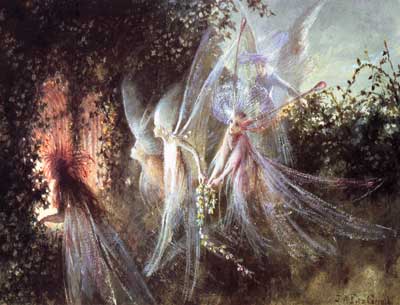
In conclusion, the lesson in this poem is to never underestimate the fairies. Yes they have a sweet spot for their own people and they will do anything for their people, like protect them. So under that softness is a tough interior.
Posted by L. J. Lewis at 3/15/2010 11:08:00 AM 3 comments
Blog 2 Poetry
The poem I choose was The Fairies, by William Allingham. I found this poem at www.poetry-archieve.com/a/the_fairies.html by using www.google.com. 
THE FAIRIES
by: William Allingham (1824-1889)
Up the airy mountain,
Down the rushy glen,
We daren't go a-hunting
For fear of little men;
Wee folk, good folk,
Trooping all together;
Green jacket, red cap,
And white owl's feather!
Down along the rocky shore
Some make their home,
They live on crispy pancakes
Of yellow tide-foam;
Some in the reeds
Of the black mountain lake,
With frogs for their watch-dogs,
All night awake.
High on the hill-top
The old King sits;
He is now so old and gray
He's nigh lost his wits.
With a bridge of white mist
Columbkill he crosses,
On his stately journeys
From Slieveleague to Rosses;
Or going up with music
On cold starry nights
To sup with the Queen
Of the gay Northern Lights.
They stole little Bridget
For seven years long;
When she came down again
Her friends were all gone.
They took her lightly back,
Between the night and morrow,
They thought that she was fast asleep,
But she was dead with sorrow.
They have kept her ever since
Deep within the lake,
On a bed of flag-leaves,
Watching till she wake.
By the craggy hill-side,
Through the mosses bare,
They have planted thorn-trees
For pleasure here and there.
If any man so daring
As dig them up in spite,
He shall find their sharpest thorns
In his bed at night.
Up the airy mountain,
Down the rushy glen,
We daren't go a-hunting
For fear of little men;
Wee folk, good folk,
Trooping all together;
Green jacket, red cap,
And white owl's feather!
This poem is how the people in town are scared to go hunting because of the fairies. The fairies are very protected of their land, their surroundings and their people. In the poem their outfits are describe, and to me they're dress as an army or unit. William talks about how they live along the rocky shore and they have frogs as watch dogs. So if any hunter who try to capture the fairies, the frogs, I guess, make a croaking sound to alert the fairies that someone is coming for them. Moving on to the third stanza, it talks about the king of the fairies, how he's so old and gray and losing his wits. I guess on the fifth and sixth lines of the third stanza, the king cross pass with Columbkill, known as Saint Columbkill when he's on his journeys from Slieve League to Rosses. Both locations are in the coast of County Donegal, Ireland. The king is taking this journey on a cold starry night, to have dinner with the Queen of the gay Northern Lights. Then on the fourth stanza William talks about how the fairies kidnapped a woman named Bridget seven years ago. She came back but her friends were gone and the fairies took her back, and between that night and tomorrow she died, but the fairies thought she was fast asleep. So they put her body on a large lily pad on a lake where they watch until she awake from her deep sleep. On the fifth stanza basically it’s about how any man who digs the thorns the fairies planted, he will feel the sharpest thorn on his backside at night. The last stanza repeats the first stanza, the town people are afraid to go hunting because the fairies.
Image:http://www.templates.com/blog/wp-content/uploads/2009/02/2the_fairies_vale.jpg
Posted by L. J. Lewis at 3/15/2010 12:40:00 AM 2 comments
Monday, March 8, 2010
Blog 1 About Me
My about me is on the side bar of my blog.
Posted by L. J. Lewis at 3/08/2010 10:00:00 AM 0 comments